Monday, November 5, 2018

Story Lab Week 12: Twine story software (Tech Tip)

Story Lab Week 12:

Twine story software 


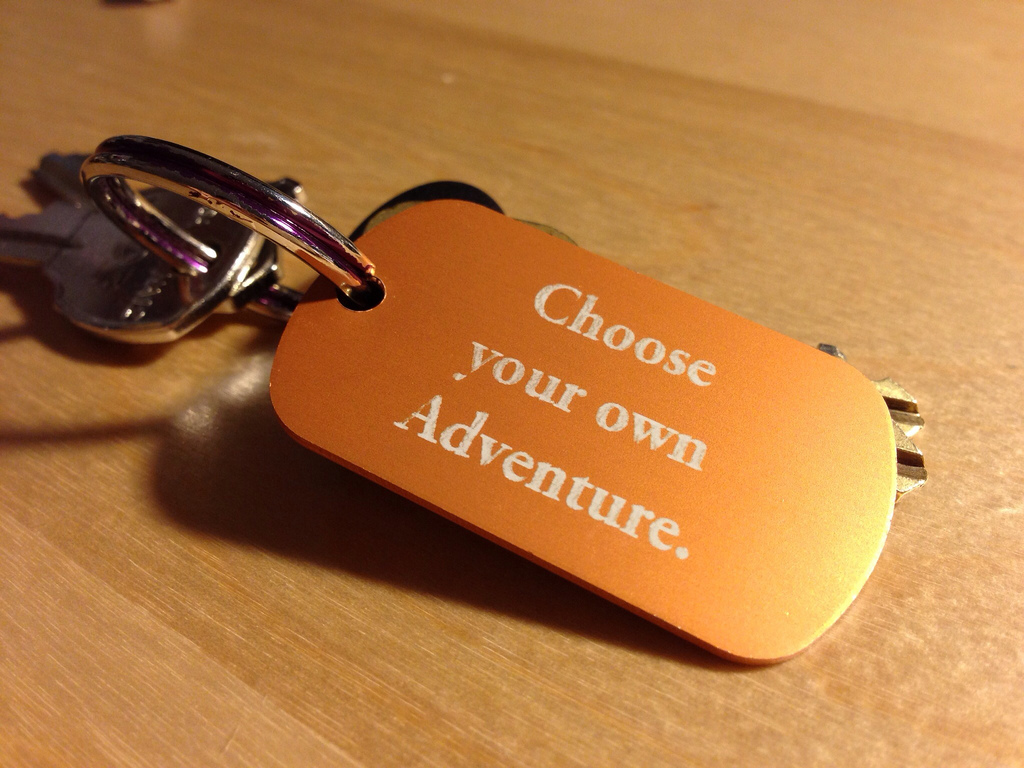
This week, I decided to do the Twine Story Software reading because of my project this semester. I definitely looked into using Twine to make my choose your own adventure story, but because my choices weren't as elaborate as this software would have preferred, I just went ahead and used the button options on google sites. I do regret not using Twine, and if I had more time, I would have put more into my adventure story! So I might pick up on using this software even after the class ends and start just making fun stories on the side that my friends could read if they choose to. I could also use this to accompany my Dungeons and Dragons campaigns with some of my groups! I love how easy it is to use this application. You can also connect more options to different things, and it just helps to keep everything organized. It's also great at loading in options and providing an "undo" so you can backtrack if you change your mind later. Something I added to my story was that some outcomes brought you back to a fork. Making this return fork was harder on the google sites option than it was on Twine! I highly recommend using this site if you'd like to make an adventure. I regret not working with it, but I do think that my story wouldn't have had as many essentials to use this application to its full potential.


Image: Adventure Tag (Flickr)
Twine Info: Twine Tech Tip

Saturday, October 27, 2018

Week 11 Story: My Grandmother's Stories

Week 11 Story:

My Grandmother's Stories


Author's Notes: My story inspiration this week is from Iagoo, the Storyteller. This story is meant to introduce the character of Iagoo, as wise and wonderful storyteller. He has a way of winning the hearts of all those he comes across through his storytelling, specifically children. I wanted to follow a format similar by describing the amazing way someone could portray stories but with using a family member instead. This isn't particularly about my own grandmother but, this is just a general idea of a grandparent. Being idolized by her grandchildren for the way she tells them stories and does things for them. It will be told through the perspective of one of her grandchildren who is of a pretty decent age (maybe 17-24?) and recounting the moments they were invested in the tales their grandmother would tell to them.


My eyes never lit up as bright for anyone as they did for my Grandmother. My siblings and I never dismissed the ideas of any of the stories she wanted to tell. She seemed to know the mysteries that lurked in the forests, and could interpret the meanings from all creatures from land and sea. Her emotional understanding was only matched by her brilliant ability to captivate an audience even just by one sentence. All my life, I knew she had a strong connection to the outdoors, the spiritual ties to the world, and all the weird things you'd expect crazy old women to be passionate about. She never taught us to be prim and proper adults, but more so the fact that she taught us moral lessons that shaped who we are today.

Her favorite way to teach us was through storytelling. She had a vast variety of stories to tell and I honestly don't remember ever hearing the same one twice. She knew fairy tales from what seemed to be all regions, and had learned most of what she knows through her parents passing the stories down to her and generations of the same trend taking place. If there was on take away you could get from my grandmother, it was that the world was a mysterious and mystic place that was full of beauty advice if you ever desired it.

We all loved my grandmother. Every single one of us. It was like a floodgate would open when my parents announced that we'd go to visit for the weekend. I remember running to the car as soon as the doors opened and jumping around in my seat waiting until I could see even the roof of her home. She had this rug that sat out by a leather recliner that she loved to sit in. Around that rug sat myself and all of my siblings, eagerly waiting to see our grandmother. She would walk out with a tray of chocolate chip cookies that to this day, no one has been able to master the way she did it. It was like she had a magic spell on us because we almost lost all train of thought on anything else but her.

Visits to our grandmother's mostly occurred during the holiday season. Whether it was snowy glaze coating the cracked pavement or crisp orange leaves falling from the trees, she was always inspired to tell a tale. My favorite times were when we could bundle up in warm blankets and sip on hot cocoa while listening to fairy tales of heroes, princesses, magicians, and even pirates. I felt connected to all parts of the world when I got to hear stories from my grandmother. She never failed at rallying us up to her while giving my parents the break they definitely deserved.

Years have passed since I was able to meet with my grandmother for stories. As that time passed, she left us to float amongst the breeze by nature. She was free to swim with the dolphins and soar the skies with the eagles now. My heart still yearns to hear those stories once more, but I knew that I had to allow them to live on through me. I will pass down her legacy as a brilliant, wise storyteller who is loved by her family. I will instill deep relationships with the earth and sky to the people who give my tales a chance. To the people who are open to getting a feel for my grandmother, I wish for them to accept me with open arms and buckle up for a new insight on life.


Image: Grandma (Pixabay)
Bibliography: American Indian Fairy Tales by W.T. Larned, with illustrations by John Rae (Un-Textbook)

Reading Notes: American Indian Fairy Tales Part B

Reading Notes:

American Indian Fairy Tales Part B


The second half of the reading for this unit was filled nicely by cute stories of a moral reason to teach the children being spoken too. I get a very nostalgic feeling of an elderly family member spreading their wisdom to their grandchildren from this section more so than the previous one. I think it's really cool that each ending word of the story sentences left you hanging on each. The adverb choices and the adjective choices were well done in my opinion. It's clear that these stories are aimed towards children, and there's no overly complicated idea that you need to get and each word has a certain amount of power that even children can grasp the importance of. You want to go ahead and skip over the other words just to get to the point because you're excited to figure out what's going to happen next! I decided to listen to an audiobook version of these stories and I felt like I was a kid again; wanting to cheer for the characters or feeling like I could be more expressive with my reactions and interjections. Something I wish I got to take from this story to further develop my story on my project would be to bring animal creatures to life and really build out a story path like this. The stories are pretty long since they are multiple pages but the actual stories go by pretty quickly as well, and I'm not sure I could be this creative with my writing. I would love to take this into consideration for the ending of my tale though! I want to be able to make enticing imagery based on my word choice, while also not being too over the top or hard to understand. Overall this was a fun read!


Image: Sunset (Wikipedia)
Bibliography:  American Indian Fairy Tales by W.T. Larned, with illustrations by John Rae (Un-Textbook)

Reading Notes: American Indian Fairy Tales Part A

Reading Notes:

American Indian Fairy Tales Part A


Transitioning into the second week of reading this unit, it was a crazy transition for me. The first story unit I read was a tad more brutal in nature for each character whereas this story is a lot more focused on love and rewarding the good. I can see why this is titled a "fairy tale" story genre just from the feel good nature in the actions of the characters, as well as the happy endings each story possessed. Something really cool about this unit of the reading was that it built off the first story that gave information about a storyteller. Then it was that storyteller to continue to tell the rest of the stories throughout the unit. The also kept the storyteller's introduction the shortest story but also the longest story. It's like it completely engulfs the other ones in the first section because the storyteller from story one is the one telling the other stories so it's like a continuation of his story, just with different content. They also set up the stories well to appeal to youthful individuals who want a happy ending and continue to follow the arc of a nice, down-to-earth character lead. You feel so wholesome after reading or listening to some of these tales and it's a sweet way to warm your heart, as opposed to the other stories I read that kinda left me to feel a bit of discomfort and shock at some points. As much as I pride myself of appreciating twists and creepy factors of stories, I wasn't expecting that from the one I read prior so it caught me off guard. It also seemed to play off so "innocently" and casual which also threw me for a loop. This unit was a nice transition from the casual brutality to mystic romance and devotion.

Image: Storyteller (Wikimedia Commons)
Bibliography:  American Indian Fairy Tales by W.T. Larned, with illustrations by John Rae (Un-Textbook)

Sunday, October 21, 2018

Story Lab Week 10: Writers Write

Story Lab

Writers Write


Hello there! I decided to do my story lab this week on the Writers Write linked page. I've been getting a bit stuck on what I'm going to do with my story regarding direction. There are so many things I want to do with it and branch out the stories into different pieces, but I know that it would be too overwhelming to make so many different endings and scenarios to go by. So I thought that maybe reading something here would help to limit the crazy branching my mind is trying to go into something that is a bit more realistic for my time and sustainable for my audience to enjoy without missing out on something! The specific pages I read under were the 3 Must Scenes That Reveal a Character and the Cheat Sheet For Writing Body Language. I chose these two subjects because the goal of my story is to meet back up with the kidnapped girl, but you also don't know if you'll reach the antagonist or not so I'd like to have a better idea as to how to bring him into the story fully personified and ready to be evil! I also wanted to get a better idea as to how to describe the protagonist in different situations solely based on body language. My story is interactive, and I want the reader to feel how the protagonist feels, so my thought process is to have more detail in the body language and make it easier to envision yourself feeling the same way. The momentum scene description really spoke volumes to me because I want to be able to build anticipation up for the final scene of the story! I also got to see a visual of a chart that helps to give an idea of how to portray feelings through the body actions of a character. My mind after reading these articles is filled with plenty of ideas on how to proceed, I just need a reliable way to tie all the pieces together! 


Image: Choose Your Own Adventure Layout (Flickr)

Reading Notes: Blackfeet Indian Stories Part B

Reading Notes

Blackfeet Indian Stories Part B


Wow is what I have to say to the second half of these stories. I remember saying in my first reading post that everything seems nostalgic to me because of the writing style. I know that at the beginning of this unit, it was said that Native American's told stories of hero's as well and that this was one of those stories. As a child, I can see how you would look up to someone that wants to help people and is triumphant in every task pinned upon him but, these stories were also pretty gruesome to read. It made me think about how they may have been different boundaries for them when telling stories and allowing their children to learn lessons. Concerning storytelling methods, It was quite difficult for me to build separations as I went forward because they liked to use the same nouns for the characters. In the beginning, there were so many people named "old man" that I wasn't aware of the difference in characters until I read further. They also liked to put emphasis on helping the elderly, which was nice. There was respect for your elders, and this showed the values that they set forth around their time period and tradition. It also helped to guide the understanding of the lessons being told from each story; though some of the content was the same each lesson was unique. Something I didn't like about the "Blood Boy" stories was that it became too predictable when he encountered different evil beings. I wanted him to be involved in more dynamic situations so that to children being told this story, he may seem like more of a hero in all aspects. It was a little unsettling that he ended up being the murder of an evil creature and all of those connected to that evil creature.

Image: Bison Hunting (Wikipedia)
Bibliography: Blackfeet Indian Stories by George Bird Grinnell (Un-Textbook)

Reading Notes: Blackfeet Indian Stories Part A

Reading Notes

Blackfeet Indian Stories Part A


I have taken a great deal of Native American courses at the University of Oklahoma, but I've never had to read any of the myth stories they had to offer based on tribe, lore, or region. This unit had plenty of different story types that varied in length and plot. Something about it that has been different than any other story I've read in this class so far is that it gives me that nostalgic storytelling method that I thought of as a child. All of the stories end with a moral lesson that can be learned throughout the tale, even if that moral lesson isn't necessarily spoken out loud. It was effortless to follow and understand for me, which helped me process each story separately. I also like that in the beginning, they were all separate stories instead of one continuous story separated by website pages. Everything was sweet, and to the point, so I didn't have to try and connect multiple pieces together that I may have forgotten early on. There is nothing wrong with continued stories, it's just helpful to have a bit of a break between reading those types or a type like this. Something else I love is that each creature from the stories used is personified to have human-like characteristics; they can converse naturally with different human characters and help to develop the story due to their influence. There is also a lot of storytelling that revolves around human relationships, specifically the connection between a man and wife. It doesn't just focus on the love and devotion portions of a marriage, but it also makes efforts to speak on the deceit and evils that can stem from it as well. Overall, I really enjoyed it and I can't wait to read the rest of this unit!


Image: Winter Wolf (Pixabay)
Bibliography: Blackfeet Indian Stories by George Bird Grinnell (Un-Textbook)

Week 13 Story: The Princess and the Robe

Week 13 Story: The Princess and the Robe Author's Note: I decided to write my story over The Princess and the Pea , which is abou...